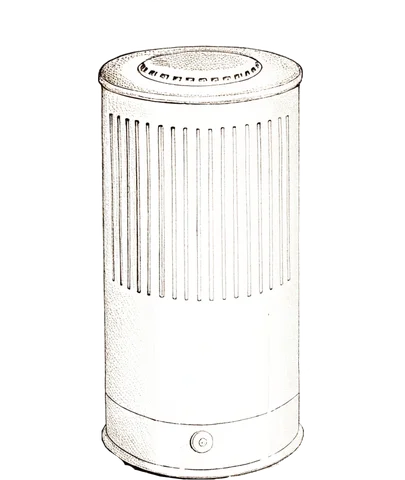
HEPA air purifiers
A true HEPA purifier is among the best-evidenced tools in home air quality. Sized correctly and run continuously, it cuts a room's fine-particle level by 40 to 80 percent in intervention trials. It filters particles only. Gases, including VOCs and the nitrogen dioxide a gas stove emits, pass straight through unless the unit also carries a real activated carbon stage.
How does HEPA air purifiers work?
A fan pulls room air through a dense mat of pleated fibers, and particles stick to the fibers on the way through. The certification test uses the particle size filters find hardest to catch, about a third of a micron. To qualify as true HEPA, a filter has to trap all but a few of every ten thousand particles at that size in a single pass. Larger and smaller particles catch at even higher rates, which is why dust, pollen, dander, mold spores, and smoke particles are all within reach of one device. The filter can only clean air that reaches it. The fan's clean-air delivery rate, the seal around the filter frame, and filter replacement discipline decide what happens in a real room, which is why a purifier is sized to the room it serves.
What does HEPA air purifiers handle?
| Concern | Handled? | The catch |
|---|---|---|
| Fine particles (PM2.5), including wildfire smoke | Yes | 99.97% single-pass capture at the hardest particle size (0.3 microns). Room reduction runs 40-80% over time in intervention trials when the unit's clean-air delivery rate is matched to room volume. |
| Coarse dust and pollen (PM10) | Yes | Coarse particles are easier to catch than the fine fraction; per-pass capture is essentially complete. During wind-dust events, closed windows plus a running unit do the real work. |
| Pet dander | Yes | Airborne cat and dog allergen fell 77-89% with portable HEPA units in a randomized trial (Maya-Manzano 2022). Allergen settled into bedding and carpet stays until it is cleaned out. |
| Dust mite allergen | Partly | Catches the airborne fraction (a 75% reduction for one major mite allergen in the same trial), but the reservoir lives in mattresses and carpet. Encasements and keeping humidity below 50% (Arlian 1999) do that part. |
| Mold spores | Yes | Whole spores (2-20 microns) sit at the easy end of the filter's range. Filtration lowers the airborne spore load; it does nothing about the moisture feeding the growth, which is the fix that matters. |
| VOCs and formaldehyde | No | HEPA captures particles only. Gas-phase removal needs an activated carbon stage of real weight, 4 pounds of media or more, not a carbon-dusted prefilter. |
| Smog gases (ozone and NO2) | No | Gases pass through the filter. Activated carbon is the media that works on them; check the spec sheet for pounds of carbon alongside the HEPA grade. |
| Stuffy air (CO2) | No | No filter removes carbon dioxide. Only outdoor air exchange brings it down: an open door, a cracked window, or mechanical ventilation. |
How do I get HEPA air purifiers right?
Size by the room, not the marketing copy. The working formula: clean air delivery rate (CADR, in cubic feet per minute) should be at least room volume in cubic feet times 5 air changes per hour, divided by 60. A 12-by-12-foot bedroom with 9-foot ceilings works out to about 108 cfm minimum, and high ceilings break the floor-area shortcuts, so use the volume math. The bedroom is the highest-value placement, since it covers the third of your life you spend asleep, and the unit should run continuously rather than only when the air seems bad. Check the spec sheet for certified true HEPA rather than 'HEPA-type'. If gases are part of your problem, check also for an activated carbon stage measured in pounds. A leaky frame seal or an overdue filter quietly erases the rated performance.
Common questions about HEPA air purifiers
Do HEPA purifiers remove VOCs and odors?
No. HEPA media captures particles only. Gas-phase pollutants like VOCs, formaldehyde, and cooking odors need an activated carbon stage, and the carbon has to be substantial, measured in pounds on the spec sheet, not a thin carbon-coated prefilter.
Will an air purifier fix gas stove pollution?
Partly. It captures the fine particles cooking throws off, but nitrogen dioxide from the burner is a gas and passes through the filter. The source fix is a range hood vented to the outside and used every time you cook; the purifier cleans up what the hood misses.
What does 'true HEPA' mean versus 'HEPA-type'?
True HEPA is a tested standard: the filter captures all but a few of every ten thousand particles at the hardest size to catch. 'HEPA-type', 'HEPA-like', and similar labels carry no such guarantee. Confirm the certification before comparing anything else.
What size purifier do I need?
Match the clean air delivery rate to room volume: CADR in cfm of at least room volume in cubic feet times 5, divided by 60. A typical bedroom lands around 100-150 cfm, and open living areas need 250-400 cfm. Undersized units run forever and never catch up.
Do air purifiers help with allergies?
They lower the airborne fraction of what you react to. In a randomized trial, portable HEPA units cut airborne cat and dog allergen by 77 to 89 percent. The reservoir in bedding and carpet still needs encasements, cleaning, and humidity control; the purifier handles what daily life stirs back up.
Does a HEPA filter remove smoke?
For the particle part, yes. Smoke is mostly fine particles, and a true HEPA captures all but a few of every ten thousand at the hardest size to catch, which is why HEPA units are the standard tool during wildfire events. What it does not catch is the gas-phase part of smoke, the smell and the volatile organic compounds, which slip through the fibers. A unit with an activated carbon stage handles that fraction; HEPA alone leaves the odor behind.
Does a HEPA filter remove formaldehyde?
No. Formaldehyde is a gas, and HEPA media traps particles only, so it passes straight through. Removing it takes an activated carbon stage, and plain carbon does a poor job on formaldehyde specifically; the media that works is a heavier permanganate-impregnated or specialty carbon. Source control does more than any filter here: choose low-emission certified materials and air out new cabinetry, flooring, and mattresses before regular use.
Does a HEPA filter remove radon?
No. Radon is a radioactive gas that seeps up from the soil, and no air filter removes a gas. Its decay products do attach to airborne particles, so a running HEPA can pull some of them out of the air, but this is not a recognized radon fix and does nothing about the gas still entering the home. The real answer is to test first, and if the level is elevated, install sub-slab depressurization, which vents soil gas outside before it gets in.
Does a HEPA filter remove CO2?
No. No filter removes carbon dioxide, HEPA or otherwise, because CO2 is a gas and even activated carbon does not scrub it at room scale. The only thing that lowers indoor CO2 is bringing in outdoor air: open the bedroom door, crack a window when the outdoor air is clean, or run mechanical ventilation. A purifier moves air around the room but adds no fresh air, so the CO2 number does not budge.
Do HEPA filters remove PFAS?
Not in the sense the question usually means. PFAS is primarily a drinking-water problem, not something you pull out of room air with a purifier, and the tools that work on it live on the water side: reverse osmosis and certain certified filters. HEPA and activated carbon are air-side media and are not a PFAS-in-water solution. There is an open question about PFAS bound to household dust and treated textiles, but the breathe-it-in route for residential PFAS is not yet well established.
Do air purifiers with HEPA filters really work?
A certified true HEPA filter captures 99.97 percent of particles at 0.3 microns, the hardest size to catch, on every pass of air through it. In real rooms the time-averaged reduction lands at 40 to 80 percent, since the unit can only clean the air that reaches it while the source keeps emitting, and placement, leakage, and filter condition all cut into the gap. The gap between those two numbers is sizing and run time, not filter quality. 'HEPA-type' is not the certified grade and does not carry the 99.97 percent figure.
What are the negative side effects of HEPA air purifiers?
A HEPA filter emits nothing. It is a mechanical mesh, so there is no reaction chemistry and no byproduct. The side effects come from what manufacturers bundle alongside it: an ionizing or ozone-generating stage produces ozone, which California banned in ozone generators sold as air cleaners in 2010 under AB 2276. The costs of a plain HEPA unit are fan noise at high speed, running wattage, and a replacement cartridge on the maker's schedule.
Should I leave my air purifier on all the time?
Yes. Run it continuously rather than only when the air seems bad, because fine particles are invisible and the room's load rebuilds within minutes of the fan stopping. Continuous operation is what the sizing math already assumes: clean air delivery rate of at least room volume in cubic feet times 5 air changes per hour, divided by 60. A 12-by-12-foot bedroom with 9-foot ceilings works out to about 108 cfm on that basis.
What number should my air purifier be at?
Two different numbers get called this. A reading on the unit's display is the fine-particle concentration in micrograms per cubic meter, and the reference worth judging it against is the WHO annual guideline of 5 µg/m³, not the color of the indicator light. If the question means fan speed, use whichever speed you will tolerate running continuously. The number that actually decides performance is printed on the box: clean air delivery rate, matched to the room.
What is the 2/3 rule for air purifiers?
The 2/3 rule is AHAM's sizing shorthand: clean air delivery rate in cubic feet per minute should be at least two-thirds of the room's floor area in square feet, which supports about 4.8 air changes per hour at an 8-foot ceiling. A 300-square-foot room therefore wants 200 cfm. The shorthand breaks on vaulted ceilings and lofted rooms, where floor area understates the volume and the volume-based formula replaces it.
Sources cited for HEPA air purifiers
Every number on this method page traces to one of the 3 sources below: 2 peer-reviewed.
Peer-reviewed
Institutional & standards
- AHAM Clean Air Delivery Rate (CADR) standard for room air cleaners
Related air science
Before you buy a purifier, find out what is actually in your air.
Get your free Stasis Score from just your address