Reverse osmosis
Yes, reverse osmosis works, and it covers more water problems at once than any other filter you can put in a home. An under-sink unit certified to NSF/ANSI 58 removes lead, PFAS, hexavalent chromium, nitrate, and most other dissolved contaminants at the kitchen tap. It treats drinking and cooking water only, and the membrane needs replacement on a schedule.
How does Reverse osmosis work?
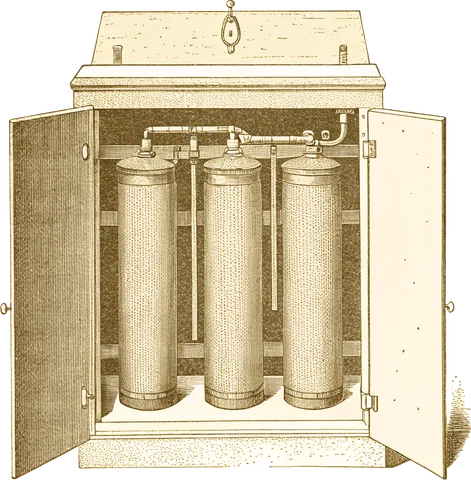
Household water pressure forces water through a semipermeable membrane with openings so small that dissolved metals, salts, and most larger molecules are left behind and flushed to the drain. The clean water collects in a small tank under the sink and comes out a dedicated faucet. Practical units are multi-stage: a sediment pre-filter protects the membrane, and carbon stages before and after it catch the chlorine byproducts and solvent-type chemicals that carbon is good at. That stack is why one under-sink unit covers so much of a water test at once. The certification to look for is NSF/ANSI 58, the standard written specifically for reverse osmosis systems. NSF/ANSI 53 covers health claims for carbon-class filters, and NSF/ANSI 42 covers taste and odor only.
What does Reverse osmosis handle?
| Concern | Handled? | The catch |
|---|---|---|
| Lead | Yes | Certified under-sink systems remove nearly all dissolved lead, and the sediment pre-stage catches the particulate lead flakes that a basic carbon-only cartridge can miss. |
| PFAS | Yes | It removed above 94 percent of long-chain and short-chain PFAS in the 73-home field study (Herkert et al., 2020), and was the only filter type consistent across the full PFAS range. Covers drinking water only, never PFAS from food packaging or cosmetics. |
| Chromium-6 (hexavalent chromium) | Yes | Rejects chromium-6 in the 90 to 97 percent range in published membrane studies. Carbon filters do not remove it, so detected chromium-6 plus an existing carbon block means an upgrade. |
| Nitrate | Yes | Carbon does not remove nitrate and boiling concentrates it, so RO is the clean fix. One standing caution: where nitrate is elevated, no baby under six months should drink even treated water, in case the system fails. |
| Trihalomethanes (THMs) | Yes | Removed at the tap, but overspecified if THMs are the only finding. A certified carbon block does that job for less. No kitchen-tap unit reaches the shower, where THMs are also inhaled. |
| Radionuclides (uranium, radium) | Yes | The only technology EPA designates as best available for uranium, combined radium and gross alpha alike (40 CFR 141.66(g)), which is why the residential answer for all three is one under-sink unit. Membrane performance runs 90 to 99 percent for uranium and radium in a 2025 review of the literature, while Nova Scotia's own field testing puts a household unit at about 90 percent for uranium, so 90 percent or better is the number to plan on, not 99. Activated carbon removes neither. |
| Hardness | Yes | Softens drinking and cooking water at the one tap it serves. It does nothing for the pipes, water heater, or fixtures behind that tap. Whole-house scale control is a softener's job. |
| 1,4-Dioxane | Partly | The molecule is small and uncharged, so a meaningful share passes the membrane. RO reduces it without being a complete barrier. The effective control is advanced oxidation at the utility. |
| NDMA and other nitrosamines | No | Small uncharged molecules that slip past RO and carbon alike. UV light is what breaks them down, a utility-scale process, so no cartridge should be sold as the answer here. |
How do I get Reverse osmosis right?
An under-sink unit connects to the cold supply line, drains to the sink drain, and may need a hole for its own faucet, typically $300 to $1,500 installed. It treats the kitchen tap only, and that is the right scope: the contaminants RO exists for are ingestion problems, so the water you drink and cook with is the water that matters. Two costs come with it. Throughput is slower than a carbon block, and some rejected water goes down the drain for every gallon produced. Maintenance is the part people skip: the membrane lasts roughly 2 to 3 years, the carbon stages 12 to 24 months, and a spent filter gives no warning, no change in taste or flow. Put replacement on a calendar instead of waiting for a sign that never comes.
Common questions about Reverse osmosis
Does reverse osmosis remove PFAS?
Yes. In a 73-home field study of home water filters, reverse osmosis removed more than 94 percent of both long-chain and short-chain PFAS, and it was the only filter type that performed consistently across the full range. The catch is that it cleans the water at one tap, and PFAS also reaches people through food packaging, dust, and cosmetics, which no water filter touches.
Does reverse osmosis remove fluoride?
Yes. Reverse osmosis is a recognized fluoride reduction technology, and systems certified to NSF/ANSI 58 carry a fluoride reduction claim, typically in the range of 85 to 95 percent. A plain carbon filter does not remove fluoride, so RO is the point-of-use route if a test shows a level you want to bring down.
Does reverse osmosis remove arsenic?
It depends on the form of arsenic. Reverse osmosis removes pentavalent arsenic, As(V), very well, on the order of 95 to 99 percent, and RO is on EPA's list of best available technologies for arsenic. Trivalent arsenic, As(III), is uncharged at normal drinking-water pH and slips past the membrane far more easily unless it is first oxidized to As(V). EPA's rule notes that pre-oxidation may be required to make that conversion, so a system meant for arsenic should oxidize the water first or be certified for the arsenic form your test finds.
Does reverse osmosis remove nitrate?
Yes. Carbon does not remove nitrate and boiling concentrates it, so reverse osmosis is the clean point-of-use fix, with rejection commonly around 75 to 95 percent depending on the membrane and the feed level. A land-grant extension guide gives the worked example that 80 mg/L nitrate at an 85 percent rejection rate leaves about 12 mg/L in the treated water. Where nitrate is elevated, no baby under six months should drink even treated water, in case the system fails.
Does reverse osmosis remove microplastics?
Almost certainly the larger fractions, though the direct evidence for point-of-use RO is still thin. RO membrane pores are far smaller than any measured microplastic particle, and membrane-based point-of-use devices removed 90 to 100 percent of PVC and 55 to 94 percent of PET particles in one 2023 study, while carbon-only devices sometimes let more through than they caught. Two limits: that study did not test RO units directly, and microplastic measurement has no standard protocol yet, so we do not repeat the crisp 99.9 percent figure that circulates in product marketing.
Does reverse osmosis remove chlorine?
Yes, though the carbon stages do that work before water reaches the membrane. A practical RO system runs water through activated carbon before and after the membrane, which is where chlorine and chloramine taste and odor come out. That carbon pre-filter is not optional: thin-film composite RO membranes are damaged by chlorine, so removing it first is what protects the membrane. Chloramine comes off more slowly than free chlorine and needs enough carbon contact, which is why catalytic carbon is used for it.
Does reverse osmosis remove healthy minerals? Is reverse osmosis water bad for you?
Yes, RO reduces dissolved minerals like calcium and magnesium along with the contaminants, and no, that does not make the water bad for you if you eat a normal diet. Drinking water is a minor source of dietary minerals, and the World Health Organization's current drinking-water guidelines set no minimum mineral requirement. The most-cited caution, a 2005 WHO review chapter, raises magnesium and taste as the real nuances, which is why remineralization is an optional preference for taste rather than a health necessity. If you want the minerals back for taste, a remineralizing cartridge adds them after the membrane.
Is a carbon filter enough, or do I need reverse osmosis?
It depends on what a test finds. Carbon handles chlorination byproducts, solvent chemicals, lead, and taste. It does not touch the dissolved inorganics: chromium-6, nitrate, perchlorate, and fluoride pass straight through it. If a test shows chromium-6, nitrate, or perchlorate, RO is the answer. If chlorination byproducts are the only finding, a certified carbon block does the job for less money.
Does reverse osmosis waste water?
Some, yes. The membrane works by splitting the stream, so a portion of rejected water goes down the drain for every gallon of clean water produced. For an under-sink unit serving drinking and cooking water the volume is a real cost worth knowing about before you buy.
Do I need a whole-house reverse osmosis system?
Almost never. The contaminants RO is built for are ingestion problems, so the tap you drink from is the exposure point and a point-of-use unit covers it. Whole-house equipment earns its place for other jobs, like scale control with a softener or shower-route chlorination byproducts with whole-house carbon.
How do I know when to replace the membrane?
You will not be able to tell, which is the trap. A saturated membrane or cartridge shows no flow change and no taste change while contaminants pass through. Plan on a new membrane every 2 to 3 years and fresh carbon stages every 12 to 24 months, scheduled in advance with the dates written down.
Is it healthy to drink reverse osmosis water?
Yes, for anyone eating a normal diet. Reverse osmosis takes material out of water and puts nothing in, so what is left is water with less dissolved content, contaminants and minerals alike. Two worries sit under the question, the minerals and the kidneys. What changes measurably is the contaminant side: lead, PFAS, chromium-6, and nitrate all come down at that tap.
Is RO water hard on the kidneys?
No, there is no evidence that low-mineral water damages healthy kidneys. The concern traces a real fact to an unsupported conclusion: reverse osmosis does remove calcium and magnesium along with the contaminants, but we found no evidence in the peer-reviewed or government literature that low-mineral drinking water harms healthy kidneys, and no drinking-water authority treats it as a kidney risk. It is also the wrong end of the problem, since water is a minor source of those minerals next to food. That answer covers healthy kidneys and ordinary drinking water. If you have diagnosed kidney disease or are on dialysis, fluid and mineral intake is a question for the doctor managing it.
What is the downside of reverse osmosis?
The downside that costs people the most is scope: reverse osmosis is routinely recommended to households whose water contains nothing that needs it, when a certified carbon block would have cleared their results for less. The rest are real but manageable. It is the most expensive of the common options to put in, typically $300 to $1,500 installed, because it plumbs into the cold line and needs a drain connection. Some water goes to the drain for every gallon produced, and output is slow enough that the unit needs a storage tank. The membrane runs 2 to 3 years and the carbon stages 12 to 24 months, with no warning in taste or flow when one is spent. It reduces dissolved minerals, and it treats one tap, so the shower stays unfiltered.
Sources cited for Reverse osmosis
Every number on this method page traces to one of the 13 sources below: 4 peer-reviewed, 6 government or regulatory.
Peer-reviewed
- Herkert, Stapleton, et al., 2020 (Environ Sci Technol Lett)
- Peer-reviewed review of chromium removal by membrane treatment
- Cherian et al., 2023, Microplastic Removal from Drinking Water Using Point-of-Use Devices (Polymers)
- Al-Shomali et al., 2025 (International Journal of Environmental Research and Public Health 22(5):727), removal of naturally occurring radioactive materials in water: membrane processes 90 to 99 percent for both radium and uranium
Government & regulatory
- CDC, Choosing a Home Water Filter
- Minnesota Department of Health, Nitrate in Drinking Water
- ATSDR, N-Nitrosodimethylamine (NDMA) ToxFAQs, 2023
- EPA, Arsenic Mitigation Strategies (Best Available Technologies; pre-oxidation, 40 CFR 141.62(c))
- 40 CFR 141.66(g), best available technologies for radionuclides: reverse osmosis is designated for combined radium, gross alpha particle activity and uranium alike
- Nova Scotia Environment, Removing Uranium From Drinking Water Using Reverse Osmosis: tests show that the unit generally removes 90 per cent of the uranium, with efficiency depending on the manufacturer and the type of membrane
Related water science
Before you buy a filter, find out what is actually in your water.
Get your free Stasis Score from just your address