Do I need a water filter?
For most US homes, yes. Nearly every chlorinated tap carries chlorine byproducts, most housing built before 2014 has lead-bearing plumbing somewhere, and PFAS rides in with some source waters and skips others. But each of those responds to a different filter, so the order matters: test your water first, then buy the filter that matches what the test finds.
Why nobody can answer this for you without a test
The answer lives in your water. Lead depends on the age of your plumbing: homes built before 2014 can have lead-bearing brass fixtures, and homes built before 1986 can have lead solder on the pipe joints. PFAS depends on your utility's source water, which is why two neighbors on different water systems can carry very different levels. Chlorine byproducts called trihalomethanes form in essentially every chlorinated supply and run higher in summer than winter. All three are tasteless, odorless, and invisible at the levels that matter. A lab test of your own tap tells you which of them you are filtering for. A filter chosen blind can handle the contaminant you do not have while letting the one you do have pass straight through.
Is a Brita good enough?
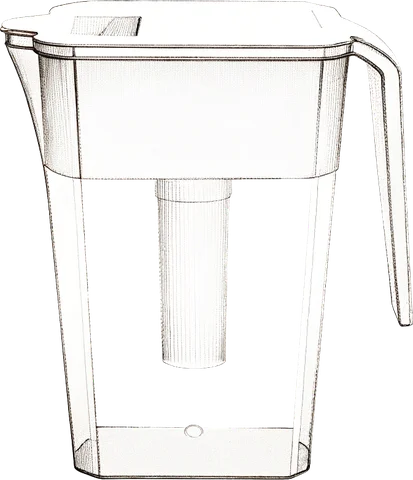
A pitcher filter (the Brita style) is a small carbon filter, and what it can honestly claim is printed on the box as an NSF/ANSI certification class. Class 53 is the one that carries health weight: a 53-certified filter has to remove 99% of lead in the standardized test, and some models carry certifications for chlorine byproducts as well. Class 58 is reverse osmosis, a step above any pitcher. So a certified pitcher earns its place against lead and chlorine taste at the kitchen tap. PFAS is where the category gets shaky. In the one strong field study of home filters, carbon removal of PFAS was widely variable, better on long-chain compounds than short ones, and in some homes filters removed none at all. Pitchers sit at the weakest end of that lineup, with the least water-to-carbon contact time. Good enough depends entirely on what your water test finds.
Matching the filter to what the test finds
Lead responds to certified carbon at the kitchen tap, because the tap you drink from is the exposure point and your own fixtures are usually the source; a whole-house system is over-engineered for that problem. PFAS reliably needs under-sink reverse osmosis, which removed more than 94% of both long-chain and short-chain compounds in field testing of real homes and is the default for any home with detected PFAS or young children. Chlorine byproducts respond to a certified carbon block at the tap, with one catch: you also inhale and absorb them in the shower, a route no kitchen filter touches, which is what shower-head carbon filters are for. And when several of these show up at once, reverse osmosis at the drinking tap covers all three.
The two ways a filter quietly fails
The first failure is the wrong tool. Whole-house carbon sold as a PFAS fix can make the water worse: in the same field testing, some systems released captured PFAS back into the water once their carbon beds saturated, and stripping the chlorine residual lets bacteria regrow in home plumbing. Whole-house carbon has a legitimate job against chlorine byproducts, in homes where a test has ruled PFAS out. The second failure is silence. A saturated filter pours at full speed and tastes completely normal, because contaminant removal quits long before the chlorine flavor comes back. Carbon cartridges generally last 12 to 24 months and reverse osmosis membranes 2 to 3 years. Put the replacement date on a calendar the day you install, since the filter will never tell you.
Where do I start?
- Pull up your utility's latest annual water quality report (the Consumer Confidence Report) and find the PFAS and total trihalomethane rows. It is free and tells you what arrived at the curb.
- Run the cold tap for 30 seconds before drinking the first water of the morning in any home built before 2014. That flushes the water that sat overnight against lead-bearing plumbing.
- If you already own a pitcher or faucet filter, look up its certification. NSF/ANSI 53 means it was tested for health claims like lead reduction. A certification only for taste and chlorine does not cover lead.
- Keep boiling in your toolkit for chlorine byproducts: about 96% of chloroform comes off in five minutes of boiling, so water you cook with is already lower in them at no cost.
- Get a lab test of your own tap before buying any hardware. The result picks the filter, and a clean result saves you the purchase entirely.
What does the science say?
What actually works?
Common questions
Is a Brita filter good enough?
For chlorine taste and for lead, a certified pitcher does a real job: NSF/ANSI 53 certification requires 99% lead reduction in the standardized test, so check that your model carries it. For PFAS, pitcher carbon is the weakest and most variable option, and reverse osmosis is the reliable answer. The certification class on the box, matched against your water test, settles the question.
What is the best water filter?
There is no single best, because each type is a tool for specific contaminants. Reverse osmosis covers the widest range, including PFAS, lead, and chlorine byproducts, but it costs the most and is overkill if your only finding is chlorine taste. Test your tap, then buy the cheapest filter certified for what showed up.
Do I need a whole-house water filter?
Rarely as a first move. Lead enters at your own fixtures, so a filter at the house inlet misses the exposure point. For PFAS, whole-house carbon performed erratically in field testing and sometimes released captured PFAS back into the water once saturated. Its strongest case is chlorine byproducts, after a test has ruled PFAS out.
How often do I need to replace a water filter?
Carbon cartridges typically run 12 to 24 months and reverse osmosis membranes 2 to 3 years. The important part is putting the date on a calendar, because a spent filter gives no warning: water flows and tastes exactly the same after the contaminant removal has stopped.
Can I skip the test and just buy a reverse osmosis system?
You can, and reverse osmosis covers more contaminants than anything else under a sink. But you would be paying the most to fix a problem you have not confirmed, and you could still miss the shower route that matters for chlorine byproducts. A test usually costs less than the system and tells you if you need it at all.
Sources cited on this page
Every number on this guide page traces to one of the 1 sources below: 1 peer-reviewed.
More guides like this one
Curious what is actually in your water?
Get your free Stasis Score from just your address