Under-sink carbon filters
Under-sink carbon filters solve the chlorine side of tap water: the taste, the disinfection byproducts chlorine leaves behind, solvent-type chemicals, and lead when the unit carries a lead certification. Dissolved salts pass straight through, so a carbon block does nothing for chromium-6, nitrate, or perchlorate, and its PFAS removal is inconsistent. Match the filter to a water test, then replace cartridges on schedule, because saturation has no taste.
How does Under-sink carbon filters work?
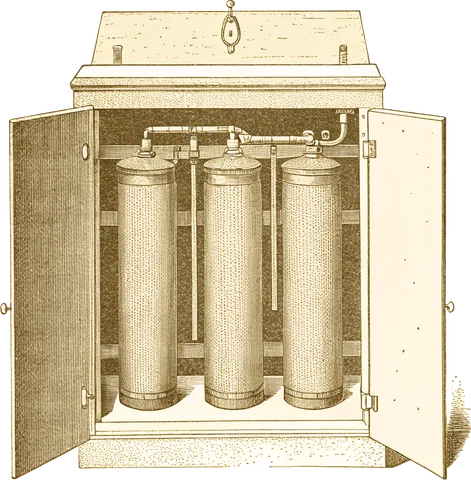
An under-sink carbon filter pulls chemicals out of water by sticking them to carbon. The unit plumbs into the cold line under the kitchen sink and forces water through a dense cylinder of compressed activated carbon. That carbon is riddled with microscopic pores, which gives one cartridge an enormous internal surface area, and organic chemicals stick to that surface as water flows past. Chlorine and its byproducts stick. So do solvent-type chemicals. Dissolved minerals and salts do not: calcium, nitrate, and chromium-6 stay dissolved, keep their charge, and slide through untouched. Anything that stays dissolved and charged passes through carbon untouched. The block format earns its place over loose granules. Compressed carbon has smaller pores and holds the water in contact with the media longer, so the same material works harder in this form than it does in a pitcher. Certification matters as much as the hardware. NSF/ANSI 42 covers taste and smell and makes no health claims. NSF/ANSI 53 is the health standard, tested contaminant by contaminant: a unit certified for lead has demonstrated 99% reduction in challenge testing, and a unit with no listing for your contaminant has demonstrated nothing.
What does Under-sink carbon filters handle?
| Concern | Handled? | The catch |
|---|---|---|
| Chlorine taste and smell | Yes | What every carbon filter does best. NSF/ANSI 42 is the certification class for taste and smell, and it makes no health claims. A filter that only improves flavor has only proven flavor. |
| Disinfection byproducts (THMs) | Yes | Look for NSF/ANSI 53 reduction of volatile organic compounds (VOCs), tested with chloroform as the stand-in chemical. It covers the water you drink and cook with; the shower route, which can carry as much of your lifetime THM dose as drinking, is untouched by a kitchen filter. |
| Lead | Yes | Only with an NSF/ANSI 53 lead listing, which requires 99% reduction in certification testing. Particles of lead shed by old brass can intermittently spike past a basic carbon-only cartridge; units with a sediment pre-stage handle that better. |
| Chlorinated solvents (TCE, PCE) | Yes | Carbon is the right tool here. EPA research found activated carbon removes many VOCs, including TCE and PCE, at up to 99.9%. That ceiling comes from treatment-scale studies, so the per-product proof is still the NSF/ANSI 53 VOC listing. |
| PFAS | Partly | Variable by nature. In the one large field study, carbon blocks removed roughly 60-70% of long-chain PFAS and about 40% of short-chain, with some units removing none at all. Reverse osmosis is the consistent performer; some NSF/ANSI 53 units now carry specific PFAS certifications. |
| Chromium-6 | No | A small dissolved ion that passes straight through carbon. Removal takes reverse osmosis or anion exchange. A home with detected chromium-6 and a carbon block has a filter that is not filtering it. |
| Nitrate and perchlorate | No | Dissolved inorganic salts slide through carbon untouched, and fluoride goes with them. Reverse osmosis handles all three. Never boil water to deal with nitrate; boiling drives off steam and concentrates what stays behind. |
| 1,4-dioxane | No | Resists carbon, and largely resists reverse osmosis too. The treatment that works is ultraviolet-based oxidation at the utility, so what works is a test and a look at your utility's treatment status. |
How do I get Under-sink carbon filters right?
Getting an under-sink carbon filter right comes down to three things: buy by the certification sheet, replace on the calendar, and know which tap it covers. Buy by the sheet, never the box copy: look for NSF/ANSI 53 with your specific contaminant named, and confirm lead is on the list if lead is your concern. Prefer a carbon block over loose granular carbon. Replace cartridges on the calendar, every 12 to 24 months for most under-sink carbon units, because a spent cartridge tastes exactly like a new one. THM capacity runs out before the chlorine taste comes back, and a PFAS-saturated cartridge changes nothing about flow or flavor. The filter treats one tap. For volatile byproducts like THMs, the shower can deliver as much of your lifetime dose as the glass, and a kitchen filter does not reach it.
Common questions about Under-sink carbon filters
Is an under-sink carbon filter better than a pitcher?
Usually yes, because an under-sink carbon block does more with the same carbon than a pitcher does. The block format has smaller pores and holds water in contact with the media longer than the loose granules in a pitcher, so more comes out before the water reaches your glass. The standard is the same either way: check the NSF/ANSI 53 listing for the contaminant you care about, because the form factor alone proves nothing.
Will it handle PFAS?
Partially and inconsistently, so an under-sink carbon filter is not a reliable PFAS tool. Field testing of home filters found carbon removed roughly two thirds of long-chain PFAS and less than half of the short-chain compounds, with wide unit-to-unit variation. Some NSF/ANSI 53 units now certify for specific PFAS compounds. For a meaningful PFAS detection, or a home with kids, reverse osmosis is the tool with consistent performance.
Does it help with hard water?
No. An under-sink carbon filter does nothing for hard water, because hardness is dissolved calcium and magnesium and carbon does not hold dissolved minerals. A whole-house softener is the fix for scale on fixtures and appliances; reverse osmosis covers drinking water at the tap. Hardness is a comfort and plumbing issue, not a health one, so there is no urgency either way.
How do I know when to replace the cartridge?
Replace on the calendar, not by taste: every 12 to 24 months for most under-sink carbon cartridges, or at the maker's stated gallon capacity, whichever comes first. Taste is not the signal, because THM capacity runs out before chlorine-taste capacity, so the water keeps tasting filtered after that protection is gone. A PFAS-saturated cartridge changes nothing you can sense either.
Does one filter under the kitchen sink protect the whole house?
No. An under-sink carbon filter treats that one tap, which covers drinking and cooking. Showers, baths, and every other fixture run unfiltered, and that matters for volatile byproducts like THMs that enter through air and skin while you bathe. Whole-house carbon treats every fixture, with real tradeoffs worth understanding first, especially in homes with detected PFAS.
Sources cited for Under-sink carbon filters
Every number on this method page traces to one of the 6 sources below: 2 peer-reviewed, 2 government or regulatory.
Peer-reviewed
Government & regulatory
Institutional & standards
- NSF/ANSI 53: Drinking Water Treatment Units, Health Effects
- NSF/ANSI 42: Drinking Water Treatment Units, Aesthetic Effects
Related water science
Before you buy a filter, find out what is actually in your water.
Get your free Stasis Score from just your address